An OpenRouter proxy should be designed around unified routing and upstream differences
OpenRouter's core value is a unified model API. According to the official API documentation, its request/response schema is very close to the OpenAI Chat API, and it normalizes different models and providers at the upper layer. It also supports model listing, fallback routing, provider routing, and tool-call parameter mapping.
Therefore, an OpenRouter proxy is not simply about proxying a single domain. It must handle model routing, upstream failures, cost, latency, logging, user identification, and fallback. A fixed egress IP can solve enterprise network and audit issues, but real quality comes from gateway policy: which models are available, which model to switch to after a failure, whether cross-provider switching is allowed, and how costs are recorded.
Residential/ISP proxies can be used for regional checks in web console QA, but API calls are better suited to a fixed enterprise egress or an internal gateway. Do not treat OpenRouter as a tool for bypassing upstream model terms.
OpenRouter Proxy Evaluation Matrix
The table below breaks down 'I want to buy a proxy' into engineering problems that can be verified. If acceptance evidence can't be written down, the requirement isn't ready for procurement yet.
| Judgment Items | Applicable Scenarios | Preferred Solution | Acceptance Evidence |
|---|---|---|---|
| Console QA | Login, model list, Key, billing, regional pages | Static residential / ISP / fixed egress | Test accounts, independent profiles, permissions, and error codes |
| OpenAI-compatible API | Switch the SDK base URL to call multiple models through one interface | Fixed HTTPS egress / API gateway | Base URL, Key, model name, streaming, and timeouts |
| Fallback routing | Switch from primary model to backup model on failure | Internal gateway + OpenRouter route | Record upstream, failure type, cost differences, and output quality |
| Team governance | Model allowlist, budget, logs, user attribution | Organization gateway | Provider routing, user identifiers, log redaction, and auditing |
OpenRouter Proxy Failure Diagnostics
Proxy failures rarely have just one cause. Separating symptoms, possible causes, and troubleshooting actions helps reduce wasted IP rotations, unnecessary provider switches, and unnecessary budget increases.
| Symptoms | Common Causes | Troubleshooting Method |
|---|---|---|
| Single model request failed | Upstream provider, model discontinued, permission issues, or parameter incompatibility | Call the model list, swap in a minimal-parameter request, and record the provider and error body |
| Quality drop after fallback | Backup models have different capabilities or parameter incompatibility | Maintain model tiers and acceptance samples for each task |
| High latency fluctuation | Upstream provider routing, queuing, regional egress, or streaming differences | Record model, provider, region, time to first token, and total duration |
| Billing hard to attribute | No user/project tags or internal gateway logs | Enforce project-level API keys, the user field, and cost reporting |
Research note: OpenRouter's model routing is not proxy rotation
OpenRouter proxy setups require separating two layers: the network proxy determines how your servers or development machines reach OpenRouter, while OpenRouter's model routing, provider selection, and fallback determine how requests are dispatched to upstream models once they enter the platform. In the official API documentation, fields such as `models`, `route`, and `provider` belong to model routing and should not be treated as an IP rotation strategy.
Official Documentation Calibration
The official sources below are used to calibrate the factual boundaries of this article, focusing on network entry points, authentication methods, proxy capabilities, and the scope of applicability for hosted browsers. Actual purchasing decisions should still depend on account permissions, terms of service, and testing in your target regions.
- OpenRouter API Reference: Used to confirm the API base URL, request structure, and the models, route, and provider fields.
- OpenRouter Model Routing: Used to confirm how model fallback and multi-model routing work.
OpenRouter Proxy Selection Tiers
| Level | Questions to Ask First | Acceptance Method |
|---|---|---|
| Network egress | Can development machines, servers, or CI reliably access the OpenRouter API? | Verify the fixed HTTP(S) egress, DNS, certificates, timeouts, and console login separately. |
| Model routing | Do you need multiple models, fallback, or a specific provider? | Record models/route/provider in the request body, and do not treat upstream failures as proxy failures. |
| Console QA | Do you need to check models, balance, usage, and logs? | Keep browser profiles separate from API keys. The fixed regional egress is only for console access stability. |
| Internal gateway | Should you add an enterprise gateway in front of OpenRouter? | Unify model allowlists, budgets, log redaction, user identifiers, and error mapping. |
OpenRouter Proxy Architecture Breakdown
- First, use a minimal Chat Completions request to confirm that `https://openrouter.ai/api/v1/chat/completions` is reachable.
- Next, test a single model, multi-model fallback, provider preferences, and streaming responses, and write each upstream selection to the log.
- A network proxy is only responsible for fixed egress and connectivity. For model failures, check the provider, rate limits, and error messages returned by OpenRouter.
- If connecting to an internal product, generate a stable user identifier at the internal gateway to support usage attribution and abuse detection.
- Console browser QA should not share production API keys, and keys should not be exposed in screenshots or logs.
Easily Misjudged Risks
- Do not use proxies to bypass model regional or platform restrictions. This article only discusses legitimate API access and console QA.
- Fallback is not a cure-all. If upstream returns a “successful” response whose content does not meet business requirements, the application layer must still perform quality checks.
- A fixed datacenter egress suits API auditing, but may not suit all web-based AI account sessions.
- When putting OpenRouter into a production pipeline, monitor upstream model changes, price changes, rate limits, and response format differences.
Deep dive: three-layer troubleshooting for an OpenRouter API proxy
When OpenRouter errors occur, don't rush to change the proxy. A single failure may come from the network egress, the OpenRouter platform, or the upstream provider or model itself. Separating these three layers of logs shows whether you should change the proxy, the route, the provider, or the business retry logic.
| Stage | Execution Method | Evidence to Retain |
|---|---|---|
| Network layer | Check DNS, TLS, fixed egress, proxy authentication, and connection timeouts. | curl results, egress IP, TLS errors |
| OpenRouter layer | Check the request body, models/route/provider, balance, rate limits, and request IDs. | Request logs, status codes, platform errors |
| Upstream model layer | Check provider, model, truncation, tool calls, and format errors. | Model responses, fallback results, quality spot checks |
If a small-sample phase cannot explain why failures happen, don't move to large-scale purchasing. The value of an AI proxy lies not in a one-time 'it can access,' but in being able to reproduce results consistently, pinpoint problems, control costs, and respect the boundaries of platforms and data sources.
Recommended Provider List
Affiliate Disclosure:Merchant buttons below may be affiliate links, and SCOKTW may earn a commission. Rankings are based on specific tasks, constraints, and testing order, not on commission rates. SeeEvaluation Methods and Full Disclosure。
OpenRouter is an API routing layer, so proxy selection should center on a fixed egress IP, console QA, model access checks, and log auditing. The ranking reflects an editorial view of testing order, not an absolute priority for every region, account, or target website.
1Proxy-Seller
Proxy-Seller is better suited for fixed IPv4, private proxies, CLI egress, and connectivity testing of low-complexity API gateways. For terminal and API scenarios such as Codex CLI, OpenRouter, and internal LLM gateways, a fixed egress IP is often easier to audit than a large residential pool.
- Suited for: Codex CLI, OpenRouter, fixed egress IP, and API gateway connectivity testing.
- Proxy types: IPv4, IPv6, ISP, residential, and mobile proxies.
- Acceptance focus: fixed IPs, protocol support, allowlists, DNS, certificates, and timeout performance.
- Purchasing advice: for CLI scenarios, test HTTP(S) proxies and gateways first, and don't apply web-based conclusions to the terminal.
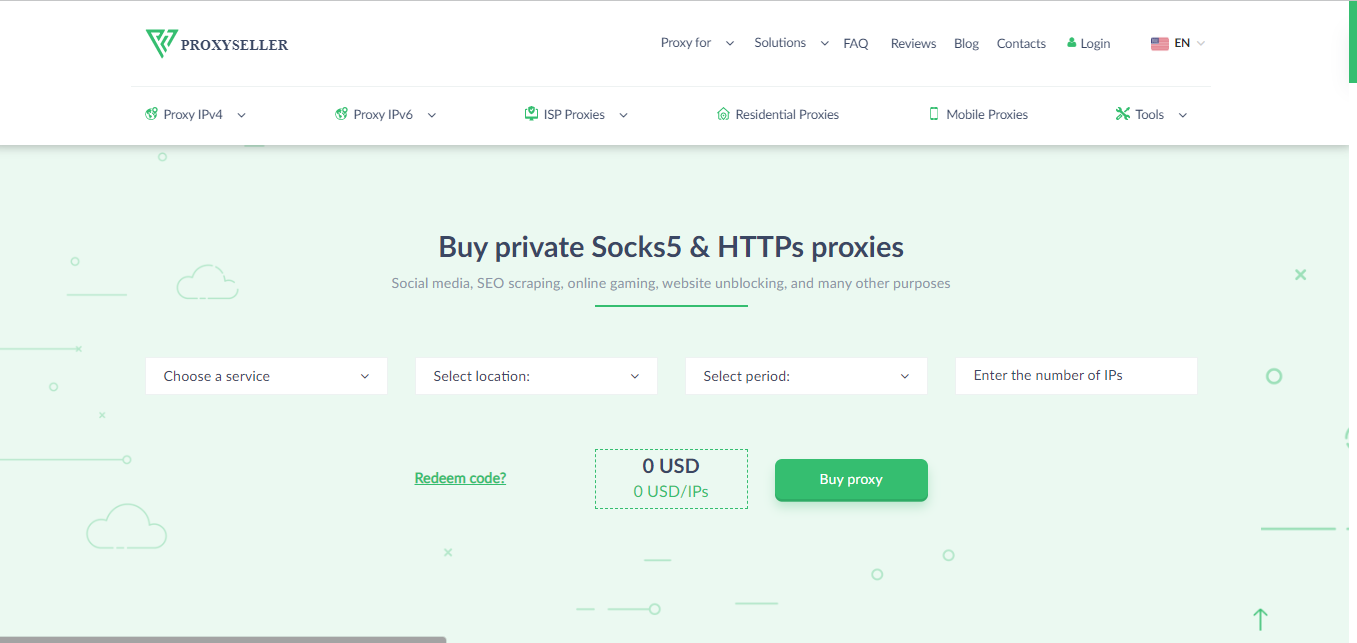
| AI Applicable Scenarios Fixed egress IP, AI CLI, OpenRouter/API gateways, private IPv4 |
A fixed egress IP supports auditing and troubleshooting, and suits command-line and API workflows. |
| Risk Control Must Verify Before Launch |
Web-based AI app sessions don't always suit datacenter or fixed IPv4 proxies, so test by platform. |
2Webshare
Webshare is suitable as a budget-friendly supplement for datacenter, static residential, and script connectivity testing. It is better suited to APIs, CLIs, low-frequency checks, and internal tools, and should not be treated by default as the only solution for AI web account sessions.
- Suitable for: low-frequency scripts, fixed egress IP, API connectivity, budget-oriented testing.
- Proxy types: datacenter proxies, residential proxies, and static residential proxies.
- Key acceptance criteria: target site acceptance, latency, concurrency limits, free/trial resources, and billing.
- Procurement advice: compare technical connectivity and cost first, then decide whether to move to production.
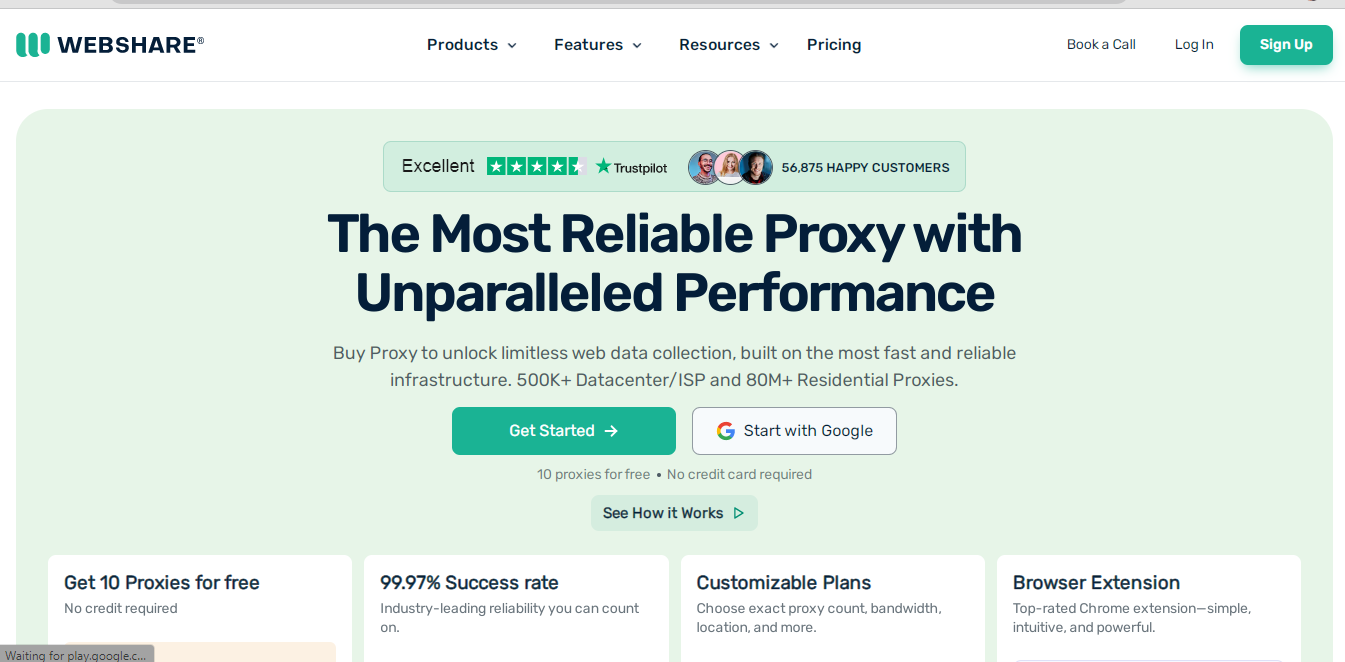
| AI Applicable Scenarios Budget fixed egress IP, CLI/API connectivity, low-frequency public page checks |
Suitable as a supplement for datacenter or budget-friendly fixed-egress testing. |
| Risk Control Must Verify Before Launch |
Highly sensitive web sessions may require residential/ISP proxy supplemental verification. |
3Bright Data
Bright Data is better suited for AI Agents, Browser API, RAG public web retrieval, and enterprise-grade regional QA. Its strength isn't a single account session. Instead, its proxy network, hosted browsers, Web Unlocker, SERP/data APIs, and compliance documentation combine into a complete data access layer.
- Suited for: AI Agent browsing, public web retrieval, Browser API, RAG data completion.
- Proxy types: residential proxies, ISP proxies, mobile proxies, datacenter proxies, and managed unblocking layers.
- Acceptance focus: success rate, render wait times, failure screenshots, regional coverage, billing, and compliance documentation.
- Purchase advice: enterprise teams should first run small-sample tasks, then scale based on successful results and actual costs.
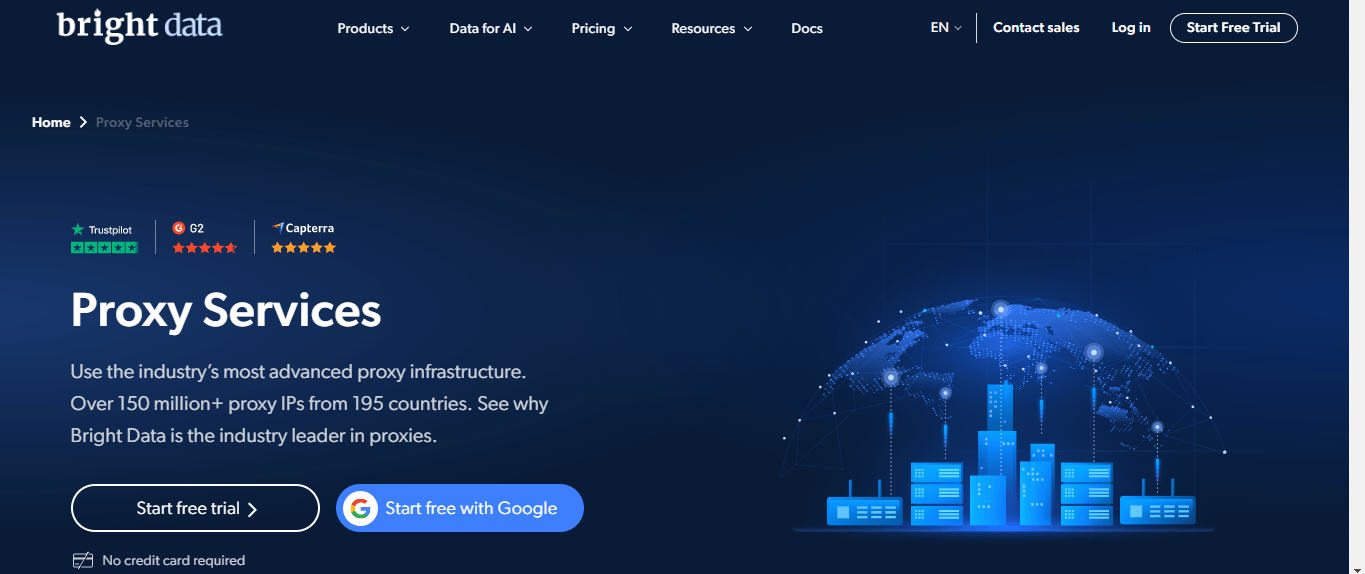
| AI Applicable Scenarios Public web access, AI Agents, RAG, Browser API |
Complete product lineup, suitable for evaluating proxies, browser rendering, and structured data delivery within a single workflow. |
| Risk Control Must Verify Before Launch |
Costs and configuration complexity are higher, so beginners should first limit budget, target domains, and concurrency. |
4Decodo
Decodo suits teams that need self-serve residential proxies, ISP proxies, and multi-region QA. It works more like a flexible mid-sized proxy pool, suitable for regional testing of ChatGPT, Claude, and Gemini web interfaces, and it can also pair with self-built Playwright or RAG scraping scripts.
- Best for: AI app regional QA, self-built browser scripts, and medium-scale public web scraping.
- Proxy types: residential, ISP, datacenter, and mobile proxies.
- Acceptance focus: availability in target regions, dashboard usability, IP rotation rules, and failure types.
- Purchase advice: test by target country and target site first, and don't judge by bundle traffic prices alone.
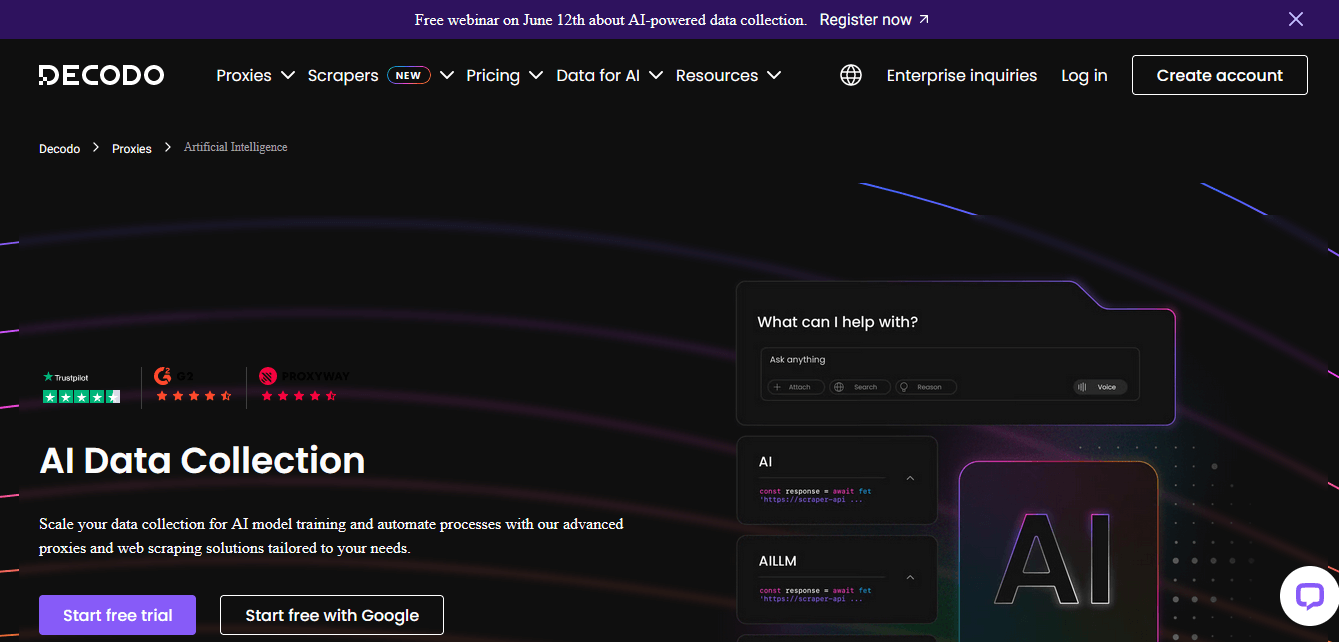
| AI Applicable Scenarios Self-serve residential proxies, multi-region QA, Playwright/Puppeteer proxy pools |
Low entry barrier; suitable for scaling from small-scale testing to a stable localized workflow. |
| Risk Control Must Verify Before Launch |
Availability pools and quality vary by region, so always rely on test runs against the target site. |
5IPRoyal
IPRoyal suits budget-conscious, small-scale AI app sessions, static residential proxies, and entry-level regional testing. It isn't a good fit for handling large-scale RAG or Agent collection from the start, but it's useful for verifying ChatGPT, Claude, and Gemini account regions and browser sessions.
- Suited for: small-scale ChatGPT/Claude/Gemini session QA and static residential proxy testing.
- Proxy types: static residential, rotating residential, datacenter, mobile, and sneaker proxies.
- Acceptance focus: inventory in target regions, session stability, refund/replacement rules, and customer support response.
- Purchase advice: start with a small number of test account environments, and don't treat a single success as proof of long-term stability.
| AI Applicable Scenarios Budget static residential proxies, AI app session testing, small-scale regional QA |
Suitable for low-cost verification of account sessions and regional availability. |
| Risk Control Must Verify Before Launch |
Inventory and quality may fluctuate in some regions, so confirm the target region before purchasing. |
Pilot plan: from small sample to full launch
Before formal purchase, it is recommended to run a short trial period to prove that the proxy solution truly matches your current AI workflow. The goal of this plan is not to succeed once, but to find stable boundaries and failure conditions.
- First list the primary model, backup models, and irreplaceable models.
- Run one model list request, one non-streaming request, one streaming request, and one tool-calling sample.
- Simulate a primary model failure and confirm whether the fallback output still passes business acceptance.
- Write model, provider, cost, latency, and error codes into a unified log.
If a trial run shows frequent security verifications, inconsistent model lists, unstable field quality, or unexplained costs, adjust the architecture and logs first instead of immediately upgrading your plan.
Post-Launch Operating Metrics
Monitoring OpenRouter must cover the network layer, the OpenRouter layer, and the upstream model layer at the same time. Only then can you tell whether to change the proxy, change the model, or adjust the request policy.
| Metric Groups | Logged Content | Evaluation Criteria |
|---|---|---|
| Network layer | DNS, TLS, connection timeouts, proxy authentication, egress IP | Used to determine whether it is a basic connectivity issue. |
| OpenRouter layer | Status codes, balance, rate limit, request ID, routing fields | Used to determine platform-side policies and billing. |
| Upstream model layer | Provider, model, latency, truncation, tool calls, format errors | Used to judge model quality and fallback logic. |
| Business layer | Answer quality, field completeness, retry success rate, unit task cost | Used to decide whether to keep this model combination. |
These metrics are recommended to start being recorded during the trial phase. A proxy solution truly worth scaling should be able to explain failures, control costs, retain evidence, and not rely on any operation that violates platform terms or access authorization.
Pre-Launch Checklist
- Clarify that OpenRouter is a model routing layer, not a compliance substitute for bypassing model service terms.
- Manage API keys, base URLs, model allowlists, budget caps, and log redaction at the gateway layer.
- Console QA uses test accounts and a separate browser profile to avoid exporting production credentials.
- Record each model's availability, fallback behavior, error codes, latency, and cost.
- Handle 401/403, 429, model retirement, upstream failures, and network timeouts separately.
Compliance Boundaries
This article does not recommend using proxies for bulk registration, payment circumvention, CAPTCHA bypass, credential import, account sharing, platform ban evasion, or any activity that violates website terms. Access to AI platforms, public web pages, and internal systems should always involve authorization, rate limits, logging, and human review.
Next reads on the same topic
- Complete AI Proxy Guide: ChatGPT, Claude, Gemini, Codex CLI, and AI Agent Scenarios
- Best AI Proxy Providers of 2026: Account Sessions, API Gateways, Browser Automation, and RAG Data Collection
- Best ChatGPT Proxies for 2026: Stable Sessions, Regional Testing, and Account Security
- Best Claude Proxies for 2026: Account Sessions, Team Workspaces, and Regional QA
- Best Gemini Proxies of 2026: Google Account Sessions, AI Studio, and Regional Testing
- AI Coding CLI Proxy Guide: Codex, Claude Code, Gemini CLI, and Gateway Routing
- 2026 Codex CLI Proxy Guide: ChatGPT Account Routing, Session Stability, and Workspace Isolation
- 2026 AI Agent Proxy Guide: Browser Access, Public Web Retrieval, and Runtime Design
- 2026 Browser API Proxy Guide: Playwright, Puppeteer, and Managed Unblocking Layers
- 2026 RAG Proxy Guide: Retrieval Pipelines, Source Coverage, and Localized Scraping