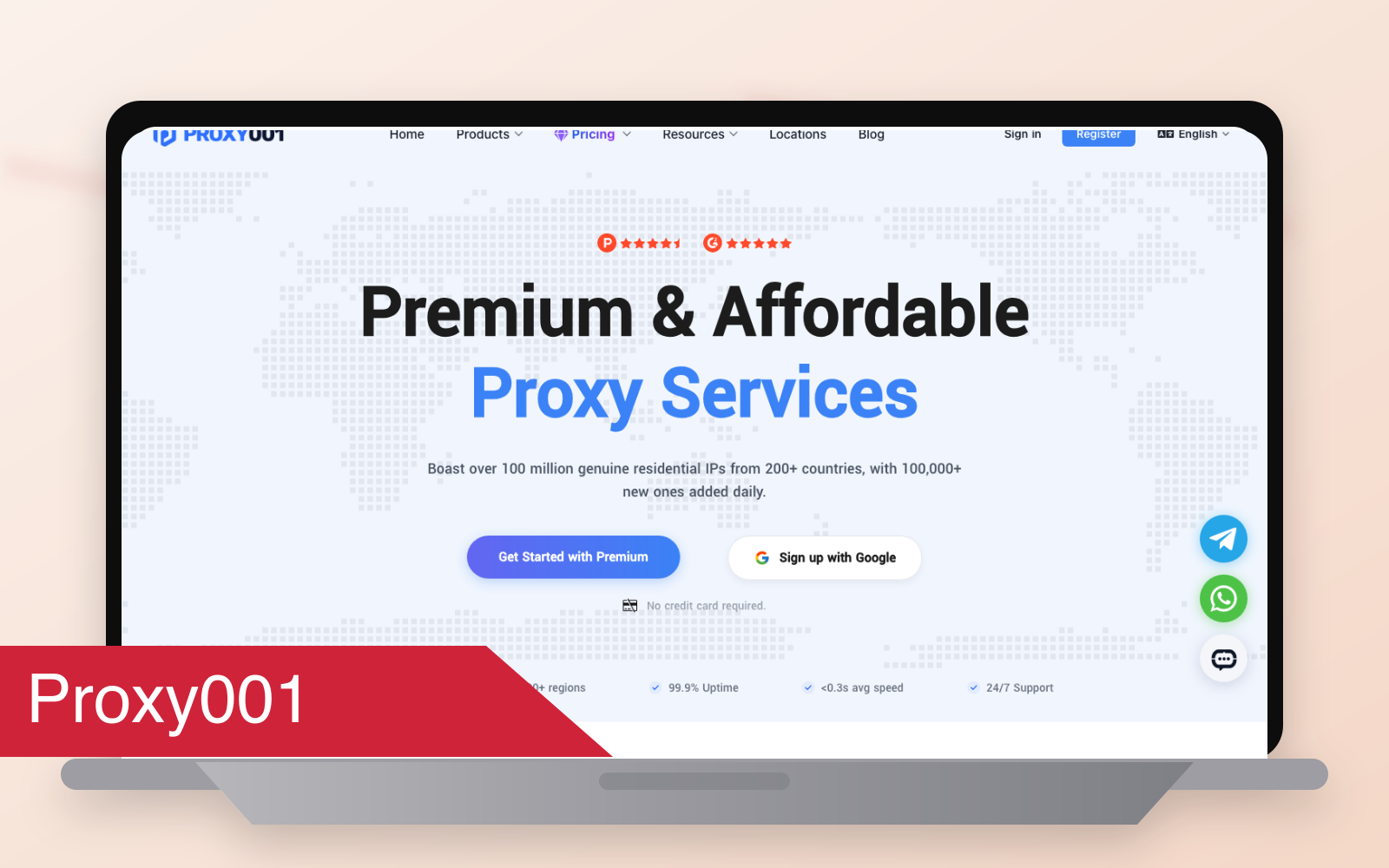
In my view, Proxy001’s biggest characteristic is not “just another residential proxy seller,” but that it puts the logic for beginners and teams together in one place. When new users enter the official homepage, they first see 100M+ IPs, 200+ regions, 99.9% Uptime,<After seeing the intuitive indicators such as 0.3s avg speed and 24/7 Support, you also see the registration entry and Google login; while those preparing to deploy a real business will quickly notice that it supports multiple products such as dynamic residential, static residential, unlimited residential, static datacenter, and static shared, and that it offers three authentication options: API, whitelist, and username/password.
The partnership materials you provided are consistent with the official public page in overall positioning: both place Proxy001 in the combination of “high-quality residential proxies + multiple product lines + support for multiple use cases.” The difference is that the partnership materials emphasize business plans and promotional selling points more, such as “500M traffic bonus for new user registration” and “supports Alipay, Apple Pay, Google Pay, cryptocurrency”; the official public page focuses more on self-service activation, regional coverage, product segmentation, and use cases. So this page combines both sides, but clearly labels time and source in the pricing section to avoid mixing different billing terms.
| Parameter | Current public information on Proxy001 |
| Core products | Dynamic residential, static residential, unlimited residential, static datacenter, static shared |
| Agency Agreement | HTTP、HTTPS、SOCKS5 |
| Authentication method | Username and password, API, whitelist |
| Targeting capability | Country-level, city-level |
| IP scale | 100M+ real residential IPs |
| Covered regions | 200+ countries / regions |
| Stability metrics | The official homepage clearly states 99.9% Uptime |
| Speed metrics | Clearly stated on the official homepage <0.3s avg speed |
| After-sales support | 24/7 Support, public pages provide Telegram, WhatsApp, email, and other contact channels |
| Trial entry | New users get 500M test traffic |
If you are encountering Proxy001 for the first time, the parameter table above is already enough to help you quickly decide whether it is worth further attention: it is not just a tool vendor selling a single residential proxy, but is clearly moving toward “multiple proxy types + multiple authentication methods + multiple payment methods + multiple business scenarios.” So for someone who wants to manage residential proxies, static proxies, and datacenter proxies in one dashboard, the barrier is low; but if you are shopping for one very narrow need, such as buying a batch of cheap shared proxies for low-risk temporary tasks, whether to choose it still depends on how price-sensitive you are.
1Proxy001 pricing and plans
Based on the information on the official homepage, Proxy001’s product line includes at least Residential Proxies, Static Residential Proxies, Unlimited Residential, Static Datacenter Proxies, and Static Shared Proxies. In the partnership materials you provided, there are also business-facing price points such as “dynamic ISP proxy $0.55/GB, static residential proxy $0.16/IP/day, unlimited residential proxy $100/day, datacenter proxy $1.9/IP.” So I’d suggest understanding it on two levels: the official site is the public entry point you check before ordering, while the partnership materials are more like business promotion info or a pricing set for a certain campaign period.
Such differences are not unusual in the proxy industry, because common billing methods for residential proxies include per GB, per IP, per day, per month, per concurrency, or per traffic pool. The presentation may also differ across regions, product lines, and campaign periods for the same vendor. What really determines your cost is not just the number itself, but the unit behind it, the minimum order quantity, whether unlimited traffic is included, whether IP rotation is supported, whether concurrency is limited, and whether sticky session duration is available. So when looking at prices, never just screenshot one number and pay.
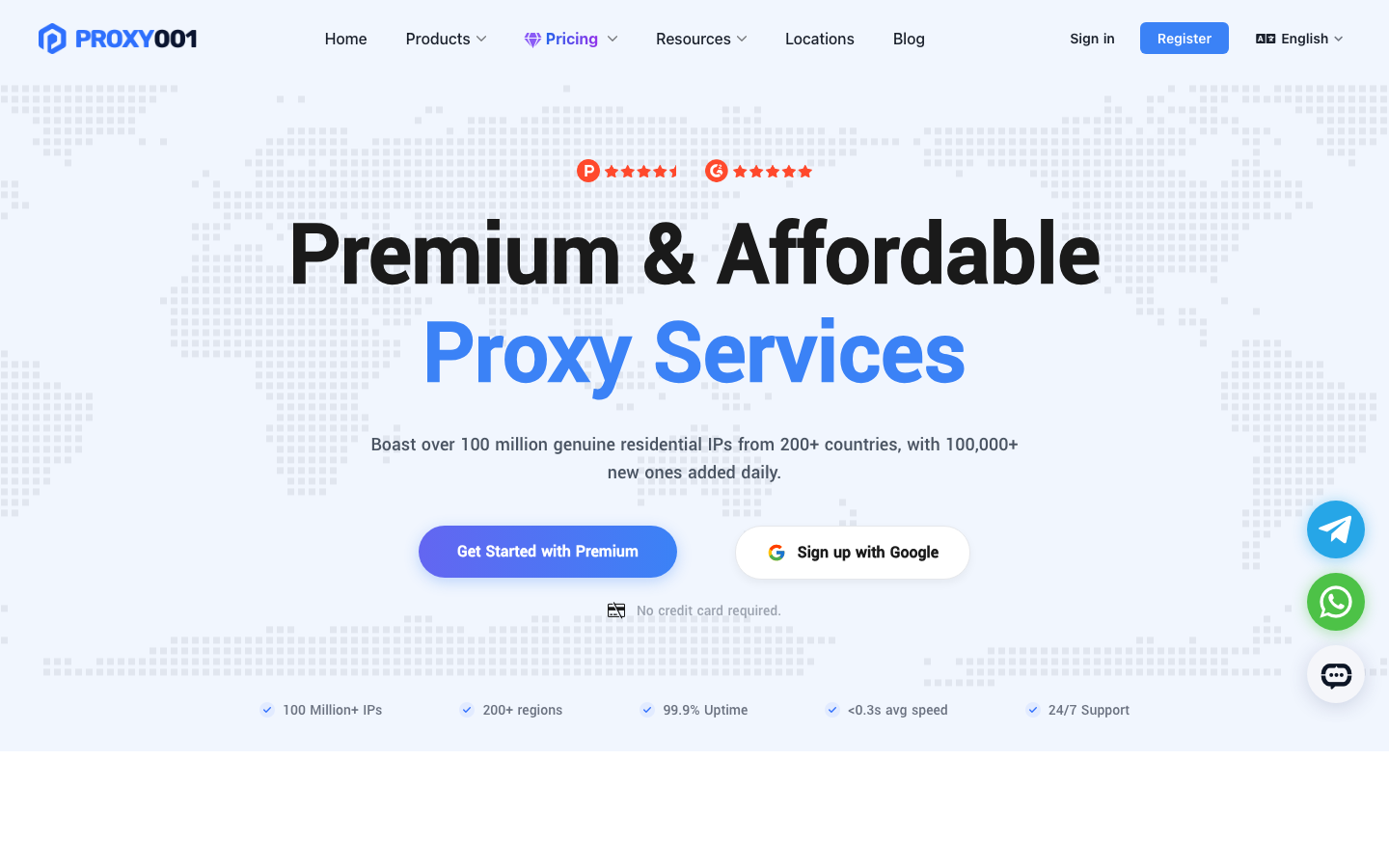
The image above comes from the homepage display on the official Proxy001 website. At least in terms of information presentation, it states the key selling points clearly: dynamic residential starts at $0.55/GB, and static datacenter is $1.9/IP; these two match the partnership materials. Static residential and unlimited residential are better checked again on the specific purchase page after you click in, so you can confirm the plan unit and limitation notes.
Proxy001 plan overview |
Dynamic residential | Static residential | Unlimited residential | Data center | Static shared |
|---|---|---|---|---|---|
Public starting price / data reference |
$0.55 /GB |
$0.16 /IP/day* |
$100 /day* |
$1.9 /IP |
$0.6 /IP |
Supports session/rotation |
|||||
Suitable for long-term fixed identity |
|||||
Suitable for budget-sensitive beginners |
Prices marked with * come from the partnership materials you provided, and they do not necessarily equal the final number everyone will see when ordering on the official site. Before making a real purchase, I suggest checking the official product pages again to confirm the terms “per day / per month / per IP / per traffic” one by one. For team procurement, this verification step is very important, because if one unit is misunderstood, the cost difference can easily be several times over.
2Proxy001 infrastructure, speed, and stability
I will not say “very fast” or “definitely industry-leading success rate” without real page evidence, but Proxy001 at least presents the metrics it is willing to publicly commit to in a fairly complete way: 100M+ real residential IPs, 200+ regions, 99.9% Uptime,<0.3s average speed, 24/7 Support. For a proxy vendor, these figures are not absolute results, but part of the product narrative it chooses to present publicly. What is actually valuable to users is that these metrics match its product structure: if a platform offers dynamic residential, static residential, unlimited residential, and datacenter all at once, then it does need a more complete network resource scheduling and backend management capability.
In addition, the official page also highlights "Developer-Friendly Tools & “Easy Integration” is called out separately, with API, SDK, Python, Node.js, Puppeteer, and Selenium explicitly mentioned. That is important for users doing bulk data collection, marketing automation, price monitoring, or account farming. Many vendors also sell proxies, but their dashboards are only suitable for manually copying IPs; Proxy001 is clearly not limited to “selling an IP list,” but is trying to turn proxy integration into an engineering workflow. So if you can script, Proxy001 is much more usable than a small platform that only gives you a host:port.
| IP scale Official homepage public information |
100M+Real residential IPWide coverage Can be rotated Suitable for scraping and ad delivery |
|
| Covered regions Official homepage public information |
200+Countries/regionsCountry-level targeting City-level targeting Suitable for localization testing |
|
| Network stability Official homepage public information |
99.9%UptimeSuitable for long tasks Suitable for batch operations Suitable for team use |
|
| Access capability Public copy + partner materials |
HTTP / HTTPS / SOCKS5API / whitelist / username-passwordScript-friendly Multi-environment compatible Scalable |
|
If you care more about “script compatibility” and “team dashboard management,” then Proxy001’s infrastructure story is valid; if you only care whether a specific site can bypass anti-bot checks instantly, you cannot rely on these marketing numbers alone and still need to test with your target site. The vendor’s publicly stated success rate is not the same as success rate in your own scenario, and that needs to be clear in advance.
3Coverage regions, geotargeting capabilities, and use cases
Another major selling point of Proxy001 is that it presents coverage and use cases very directly: the page states coverage of 200+ countries and regions, with country-level and city-level targeting; the use cases include data collection, e-commerce operations, social media marketing, ad verification, flash-sale purchasing, price monitoring, search engine optimization, brand protection, AI training data collection, and more. This kind of scenario breakdown is not new, but at least it shows Proxy001 is not treating all users as experienced buyers who already know how to use proxies after purchase; it is intentionally creating explanation paths for different industries.
For ordinary site operators and marketers, the most valuable features are country/city-level targeting and multi-protocol support. If you are doing SEO ranking monitoring, you need SERP results from different regions; if you are doing e-commerce product selection, you need prices and stock levels as seen in different countries; if you are doing social media matrices and ad verification, you need stable access from the target region. For data teams, the key point is the 100M+ residential pool and the stated addition of 100,000+ IPs per day, which suggests it is better suited to medium- to long-term data scraping tasks rather than buying a few fixed IPs and calling it a day.
| Proxy001 use cases Compiled based on public pages and partner materials |
Data collection, cross-border e-commerce, social media marketing, ad verification, product drops, price monitoring, brand protection, SEO ranking tracking, account registration environment isolation, AI / LLM training data collection |
From my perspective, Proxy001 is most suitable for two types of users: first, experienced users who already know which protocol, which targeting level, and which authentication method they want, and can directly map the product line to their needs; second, people who are still in the trial-and-error phase but do not want to be blocked by technical barriers at the start, because the 500M offer for new users is low enough to test their workflow first and decide whether to scale up later.
4Proxy001 advantages
If I only look at the “pros summary,” I would group Proxy001’s advantages into six keywords: complete product line, flexible authentication, broad coverage, friendly entry, clear scenarios, and solid support. I’ll expand them one by one below so you can compare them against your actual needs and decide whether it fits.
1. Complete product line, suitable from beginners to team procurement
Many proxy vendors are especially strong in only one product area, such as datacenter only, static residential only, or unlimited traffic only. The advantage of Proxy001 is that it does not force users into a single product bucket, but instead puts dynamic residential, static residential, unlimited residential, static datacenter, and static shared in the same site framework. That means you can start by testing with dynamic residential, then migrate stable workloads to static residential or datacenter proxies that are better suited for long-term identities, without having to migrate the whole platform.
2. Username/password / API / whitelist are all practical authentication methods
This is extremely important. Many people buy proxies and only pay attention to IP and price, while ignoring how they connect, which directly affects future operations cost. Username/password authentication is suitable for quick testing and personal use; whitelisting is suitable for stable server environments; API is better for team script scheduling and automated management. Proxy001 offers these three methods together, which shows it is prepared for different user profiles. For developers connecting Python, Node.js, Puppeteer, and Selenium, this flexibility is much more comfortable than vendors that only give fixed credentials.
3. The 500M for new users and multiple payment methods lower the cost of trying it
The partnership materials explicitly mention a 500M traffic bonus for new user registration, which is very useful for people who want to test a workflow first. The reason is that the worst mistake with proxy products is to jump straight into a large plan before testing the scenario, only to discover that the target site is heavily restricted, the script is not written well, or the authentication method is mismatched, so the money is spent before the problem is solved. By lowering the trial barrier and combining it with payment methods such as credit cards, Alipay, cryptocurrency, Google Pay, and Apple Pay, Proxy001 clearly reduces the psychological barrier for a first try.
4. Easier for developers and automation users to get started
The official public copy explicitly mentions Python, Node.js, Puppeteer, and Selenium, which is a plus in my view. It at least shows Proxy001 does not treat “developer integration” as something added later in support, but is willing to present it as a public selling point. For people doing script-based collection, ad verification, automated browsing, or cross-region environment testing, this attitude usually means the backend docs, integration examples, and technical support are also more mature.
5. The use cases are described clearly enough, not vague marketing
I am not a fan of proxy vendors that only say “suitable for various business scenarios,” because that kind of wording carries almost no information. Proxy001 at least clearly lists use cases such as data collection, e-commerce, marketing, ad verification, price monitoring, brand protection, and AI training. Although this is still marketing language, it genuinely helps users: you can quickly tell whether you are leaning toward “high-concurrency rotation” or “long-term fixed identity,” and whether you are more focused on “low-cost trial” or “stable long-term operation,” which reduces the chance of choosing the wrong plan.
6. The public support channels are complete, which helps with business and after-sales communication
At the bottom of the public page, Proxy001 directly provides email, Telegram, and WhatsApp. This is more practical than only leaving a ticket form, because it lets you verify after-sales response speed before buying, and also makes it easier to find someone quickly for procurement, top-up, plan confirmation, and payment issues. For proxy products, after-sales is not just a nice-to-have; it is a key part of whether you can keep the business running.
5Proxy001 considerations and potential drawbacks
I will not write Proxy001 as a platform that “has no drawbacks,” because any proxy vendor entering real business environments must face issues such as target-site anti-bot controls, differences in plan wording, concurrency management, session stability, payment risk control, and misunderstandings in after-sales support. The next two points are what I think you must consider before actually buying.
1. Pricing terms must be checked item by item before ordering
At present, Proxy001’s partnership materials and official public page show some pricing differences for certain products. For example, the dynamic residential $0.55/GB and datacenter $1.9/IP line up, but static residential and unlimited residential may appear with different wording such as per day, per IP, or per month. This does not necessarily mean the platform has a problem; it is more likely that public retail prices, business prices, promotional prices, and plan prices are all mixed together. The safest approach is to confirm with customer support before paying: product name, billing unit, minimum order amount, whether traffic is unlimited, and whether IP rotation is supported.
2. Real residential IP does not mean your target site definitely will not block it
“100% real residential proxies” is a strong selling point, but it should not be understood as “every website will work perfectly 100% of the time.” The real factors that determine success rate also include the target site’s anti-bot strategy, your request frequency, browser fingerprint, account quality, cookie state, login behavior, and script pacing. In other words, Proxy001 can significantly improve your chance of getting high-quality residential exits, but it is not a pass that removes all risk controls. For highly sensitive sites such as social media, ad platforms, and e-commerce backends, you should start with a small-scale test before deciding whether to expand.
6FAQ
These questions are basically the ones people ask most when they first come across Proxy001. I have summarized them based on public pages, partnership materials, and industry common sense to help you avoid extra detours.
Who is Proxy001 suitable for?
Suitable for people doing data collection, e-commerce operations, ad verification, SEO monitoring, brand protection, and social media marketing, and also suitable for teams that need country-level or city-level proxy targeting. If you only need a one-time, very low-budget shared IP and do not care at all about the dashboard or after-sales support, Proxy001 may not be your cheapest option.
Which protocols does Proxy001 support?
The partnership materials clearly list HTTP, HTTPS, and SOCKS5, and the public materials also focus on these three protocols, so it covers common scraping, automated browsers, script requests, and account environment isolation.
Is Proxy001's authentication flexible enough?
Enough. Username/password is suitable for quick start, API is suitable for programmatic management, and whitelist is suitable for stable server environments. For multi-script, multi-node, multi-region tasks, this is easier to manage than platforms that only offer a single username/password method.
Is the new-user 500M traffic worth claiming?
Worth it. Because the worst thing about proxy products is “pay first, then discover it is not suitable for the business.” Although 500M is not much, it is enough to run your target site first, test the authentication method, verify script compatibility, and confirm whether you really need a larger plan.
If I want long-term stable account environments, which type of plan is more suitable?
In general, long-term fixed identity is more suitable for static residential or static datacenter; short-cycle rotating collection is more suitable for dynamic residential. Which type to choose depends on whether your target site’s anti-bot control leans more toward residential environments, or whether it values fixed exits and cost control more.
Is Proxy001 suitable for AI / LLM data collection?
From the public page copy, it does treat AI Training as an important use case, which means the platform is willing to position its high coverage, high concurrency, and global distribution capabilities toward this kind of task. But whether it truly fits your specific training-data workflow still depends on the stability of your target source, your concurrency needs, and compliance requirements.
Proxy001 review summary
If I had to summarize Proxy001 in one sentence, I would say: it is a proxy platform that “broadens the product line, lowers the integration barrier, and clearly communicates its public selling points.” For someone encountering residential proxies for the first time, the new-user 500M offer, HTTP/HTTPS/SOCKS5, username/password/API/whitelist, and multiple payment methods are already attractive enough; for team users, putting dynamic residential, static residential, unlimited residential, datacenter, and static shared in one platform also means the upgrade path is smoother later on.
But just as important is the fact that Proxy001’s pricing terms differ across information sources, so never mix the public page, the materials, and your actual checkout page together. The correct approach is to first validate your target workflow with the included traffic or a small plan, then decide whether to scale up. As long as you are willing to do the “test first, purchase later” step properly, platforms like Proxy001 are more worthy of long-term cooperation than platforms judged only by low price.